
How to Turn Profile Visitors Into Followers, Leads and Opportunities
Learn how to turn profile visits into meaningful growth by making your value clear, creating the right next step, and measuring follows, leads and business opportunities separately.
 Sep 29, 2026
A profile visit is not the same thing as attention.
It is a decision point.
Someone saw a Reel, TikTok, Short, post, comment, collaboration or recommendation and became curious enough to check who was behind it.
Now they are asking, often without realizing it:
Who is this for?
Why should I care?
What should I do next?
If your profile cannot answer those questions quickly, the visit ends there.
The goal is not to convert every visitor into a follower.
Some people should follow.
Some should join your email list.
Some should click a product.
Some should inquire about working with you.
Some should simply understand what you do and remember your name.
A strong creator profile does not force everyone into the same action.
It makes the right next action obvious.
Profile conversion is not one metric
Creators often talk about "converting profile visitors" as if there were a single outcome.
There are at least three.
Follower conversion
The visitor decides your future content is worth seeing again.
Lead conversion
The visitor gives you a way to continue the relationship outside the feed, usually through email, a form, a waitlist, a community or another owned contact point.
Opportunity conversion
The visitor becomes commercially useful.
That could mean:
- a brand inquiry;
- a client request;
- an affiliate click;
- a product sale;
- a speaking invitation;
- a media request;
- a collaboration;
- a job opportunity.
Those outcomes need different paths.
A profile optimized only for "Follow me" may grow an audience while doing very little for the creator's business.
A profile optimized only for selling can make a first-time visitor feel like they walked into a checkout page.
The job is to build a sequence.
Content creates curiosity.
The profile creates understanding.
The next step creates a relationship or opportunity.

Your profile has four jobs
Before changing fonts, emojis, highlights or links, make sure the profile can do four things.
1. Identify
A visitor should understand who you are.
Not your complete life story.
Just enough context to place you.
"Designer" is identification.
"Freelance product designer helping early-stage SaaS teams improve onboarding" is identification plus relevance.
2. Position
A visitor should understand what they can expect from you.
This is the promise behind the follow.
If your bio says "fitness, travel, lifestyle, mindset, business, food and daily life," you have technically described your content.
You have not made the decision easier.
A useful profile creates a pattern.
That pattern might be:
Budget travel for people with full-time jobs.
Practical strength training for runners.
Camera tutorials for solo creators.
Career advice for first-generation professionals.
You do not need to reduce yourself to one topic forever.
You do need to give a new visitor a reason to know what following you means.
3. Prove
The profile needs evidence that the promise is real.
Your recent content, pinned posts, featured videos, playlists, highlights, portfolio links and public results can all provide proof.
A sentence says what you do.
Proof shows that you actually do it.
4. Direct
The visitor needs a next step.
Follow.
Watch this.
Start here.
Join.
Download.
Read.
Shop.
Work with me.
The profile is not finished when it explains who you are.
It is finished when the visitor knows what to do with that information.
Write the bio for the person who does not know you yet
Creators naturally write profiles from the inside out.
They use words that make sense to existing followers, friends or people already familiar with their work.
A new visitor has none of that context.
A useful bio usually answers some version of:
What do you create?
Who is it useful for?
Why are you credible or distinct?
Where should I go next?
Not every profile needs all four written literally.
Sometimes the content itself establishes credibility.
Sometimes the category is obvious from the username and visual language.
Sometimes personality is the differentiator.
But clarity has to exist somewhere.
Consider the difference:
Creator | entrepreneur | dreamer
versus:
I test creator tools and workflows so solo creators can publish faster without building a team.
The first describes identity.
The second gives a stranger a reason to stay.
Your recent content is part of the landing page
A profile is not just the bio.
The visitor immediately sees content.
That means your pinned posts, featured videos and recent publishing choices are part of the conversion experience.
Use them deliberately.
A strong set of pinned or featured content might include:
- Orientation: what you create and who it is for.
- Proof: one of your strongest examples, case studies or results.
- Depth: content that shows how you think, not just what performs.
The exact tools vary by platform.
YouTube lets creators customize the channel Home tab with a trailer, featured video and sections, while the Profile area can carry the channel description and external links. The point is not to fill every available module. It is to help a first-time viewer understand where to begin.
Source: YouTube Help: Channel customization.
On Instagram, recommended content can introduce creators to people who do not follow them. Meta has specifically described ranking changes intended to give smaller original creators more opportunities to reach new audiences through recommendations.
That makes the profile more important, not less.
Discovery can happen before familiarity.
Source: Meta: Helping creators find new audiences.
Do not confuse more links with a clearer next step
Modern platforms give creators more outbound options than they used to.
Instagram supports multiple profile links.
YouTube currently allows creators to display up to 14 channel profile links, with the first link receiving prominent placement near the Subscribe button. Creators can also add business contact information.
TikTok currently allows Personal Accounts with at least 1,000 followers to add a website link to the profile, while Business Accounts can add a website link. Availability and account requirements can change, so check the platform's current rules for your account and market.
Sources: YouTube Help: Manage your channel profile and TikTok Support: Account types and website links.
More links create capacity.
They do not automatically create clarity.
If a visitor opens your profile and sees:
- newsletter;
- podcast;
- course;
- shop;
- portfolio;
- YouTube;
- affiliate page;
- latest video;
- booking page;
- Discord;
- five social networks;
you have given them options.
You may also have given them work.
The first destination should match the reason most valuable visitors came to the profile.
A creator focused on brand work may prioritize:
Work with me
A creator building an owned audience may prioritize:
Join the newsletter
A consultant may prioritize:
Book a call
A product creator may prioritize:
Shop the collection
A media creator may prioritize:
Start here
The question is not "How many links can I add?"
It is:
"Which action deserves the first click?"
A Link in Bio should reduce decisions, not reproduce your internet
A link page is useful because platform profiles have limited space.
But a bad link page simply moves the clutter one click away.
Think in priorities.
Primary action
The single thing you most want the visitor to do now.
Secondary actions
Two or three relevant alternatives.
Proof
Selected work, results, testimonials, case studies or high-value content that makes the next action easier.
Business path
A visible route for brands, clients or collaborators when those opportunities matter to your creator business.
This is especially important if your audience and your customers are different people.
A food creator's followers may want recipes.
A brand manager visiting the same profile may want audience information, examples of sponsored work and a contact route.
They should not have to search through twenty recipe links to find it.
Give a visitor a reason to become a lead
"Join my newsletter" describes the action.
It does not describe the value.
A better invitation explains what happens after the signup.
For example:
One practical creator-growth breakdown every Friday.
Get the Lightroom presets used in my travel videos.
Join the waitlist for the next cohort.
Download the 12-point brand-pitch checklist.
A lead magnet is not mandatory.
The value can be the newsletter itself.
What matters is the exchange.
The visitor gives you access to their inbox, community membership or contact details.
They should know why that is worth doing.
Make business opportunities easy to route
Some profile visitors are not fans.
They are buyers.
Brand managers, journalists, event organizers, clients, recruiters and collaborators may discover you through the same content as everyone else.
Their needs are different.
A creator open to commercial work should make basic business information easy to find.
Depending on the work, that can include:
- a business email;
- the categories you work in;
- location or markets served, when relevant;
- languages;
- selected partnerships;
- portfolio or case studies;
- services or formats offered;
- a clear inquiry route.
YouTube explicitly supports business contact information on channel profiles. Instagram's Creator Marketplace also gives brands systems for discovering and evaluating creators for campaigns.
The broader lesson is simple:
Do not make a commercial visitor guess whether you are available for commercial work.
Source: Meta: New creator marketing tools for businesses.
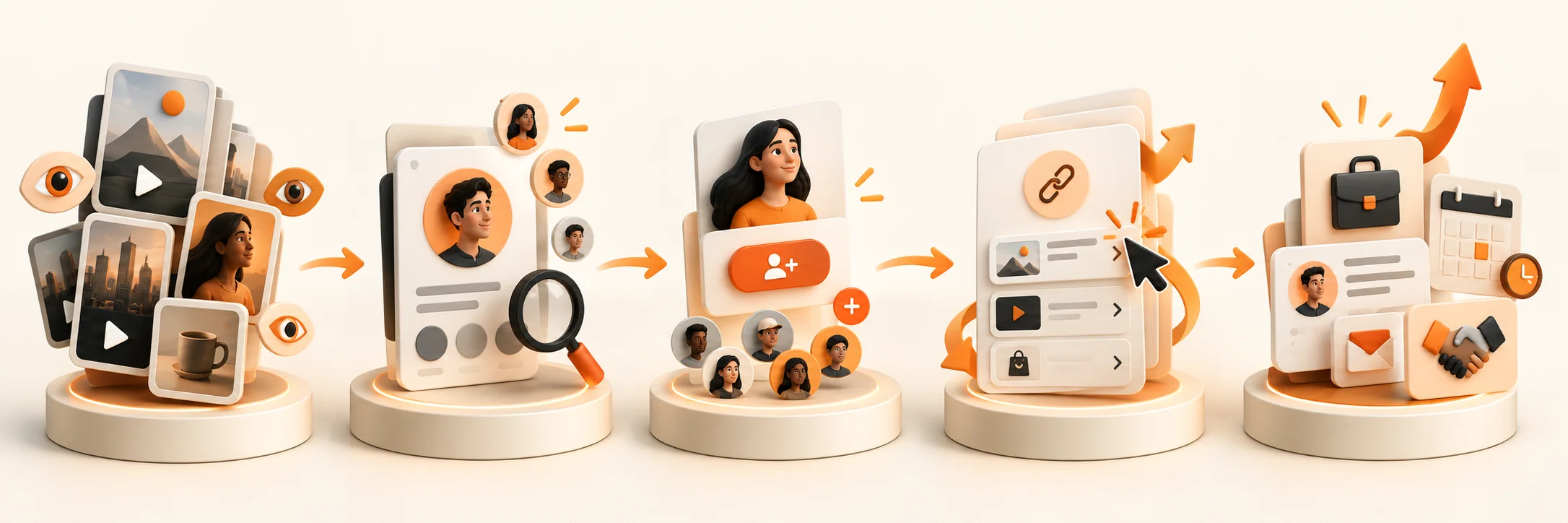
Measure the journey in stages
Follower count alone cannot tell you whether the profile is working.
If your platform and tools provide the data, separate the journey.
Profile-to-follow conversion
New follows ÷ Profile visits × 100
This asks whether profile visitors decide to continue consuming your content.
Profile-to-link conversion
Profile link clicks ÷ Profile visits × 100
This asks whether the profile generates enough intent to move people somewhere else.
Landing-page conversion
Desired actions ÷ Landing-page visits × 100
The desired action might be an email signup, form submission, sale or booking.
Opportunity conversion
Qualified inquiries ÷ Relevant landing-page visits × 100
For a creator who sells services or partnerships, raw clicks matter less than whether the right people inquire.
Not every platform exposes every metric in the same way, and definitions can change.
Use the metrics available to you.
The important discipline is to avoid collapsing the entire journey into "I gained 500 followers."
You want to know where people stop.
Diagnose the leak before changing everything
If content gets views but very few profile visits, the problem may be upstream.
The content may be entertaining without creating curiosity about the creator.
If profile visits are high but follows are low, inspect positioning and proof.
Does the profile clearly communicate why someone should return?
If follows are healthy but link clicks are weak, inspect the call to action.
Is there a compelling reason to leave the platform?
If link clicks are strong but signups or sales are weak, the profile may be doing its job.
The landing page may not be.
This distinction prevents creators from endlessly rewriting their bio when the real problem is somewhere else.
Viral traffic is not automatically valuable traffic
A creator can get a huge spike in profile visits from content that has almost nothing to do with their normal work.
That can make the profile look like it is "converting badly."
Sometimes it is doing exactly what it should.
Imagine a creator normally publishes detailed videos about freelance design.
One unrelated comedy post goes viral.
Thousands of people visit the profile.
Most do not follow.
That does not necessarily mean the bio failed.
It may mean the content attracted an audience that was never a fit for the creator's long-term promise.
This is why conversion rate needs context.
The quality of the visitor matters.
Ten thousand curious people from the wrong topic can be less valuable than 500 visitors who arrived because of the exact problem your creator business solves.
The Connekit profile test
Open your own profile as if you had never seen it.
Do not edit anything yet.
Ask five questions:
1. What is this creator about?
Can you answer without scrolling deeply?
2. Who is this useful for?
Is the intended audience obvious?
3. Why should I believe them?
Where is the proof?
4. Why should I follow?
What future value is promised?
5. What should I do if I want more?
Is the next step visible?
If one answer is weak, fix that layer.
Do not redesign the entire profile just because one part is unclear.
Turn the profile visit into a next step
Your best content can earn curiosity. Do not lose that momentum in a messy bio. Use a Link in Bio to organize the destinations that matter, give the most important action priority and make it easier for visitors to continue the relationship.
Build my Link in BioFrequently asked questions
How do I get more profile visitors to follow me?
Make the value of future content clear. Your bio, recent posts, pinned content and positioning should show what someone will continue receiving after they follow. High profile traffic with low follower growth can also mean the traffic came from content that does not match your normal topic.
What should I put in my creator bio?
At minimum, give visitors enough information to understand what you create and who it is useful for. Depending on your goals, you can also include credibility, location, business information and a clear next action.
Should I use a Link in Bio?
Use one when you need to organize multiple destinations, prioritize an important call to action or create a cleaner path to newsletters, products, work inquiries and other creator assets. The goal is not to add more links. It is to make the next decision easier.
How many links should a creator have?
There is no universal ideal number. Use as many as are genuinely useful, but establish a clear hierarchy. The most important destination should not compete equally with ten lower-priority links.
How do I turn followers into leads?
Give followers a reason to continue the relationship outside the content feed. That may be a useful newsletter, resource, waitlist, community, free tool or another clear exchange of value.
How do I get brand opportunities from my profile?
Make commercial intent easy to understand. Provide a professional contact path and, when relevant, selected work, audience context, markets, languages or formats. Brands should not need to investigate whether you are open to partnerships.
Should my profile be optimized for followers or sales?
That depends on your current business goal. Many creators need both, but one action should usually receive greater emphasis. A profile can invite people to follow while the primary link directs high-intent visitors toward a newsletter, product, service or partnership route.
Your content earns the profile visit.
The profile has a different job.
It turns curiosity into a decision.
The best profile does not try to tell a visitor everything about you.
It makes three things clear:
why you are relevant, why you are worth returning to, and where the relationship can go next.
Your creator presence deserves more than scattered links.
Centralize your brand, your content and your opportunities with Connekit.
Get started